AI Marketing Automation for E-commerce
Ecorfy builds AI marketing automation systems for e-commerce and high-ticket online stores that want to grow revenue without growing headcount. From abandoned-cart and browse-abandon flows to post-purchase and win-back sequences, AI-generated product ad creative, behavior-based segmentation, and lifecycle email and SMS — we set up the full stack, integrate your store data, and continuously refine campaigns so marketing becomes a compounding revenue and retention engine rather than a daily time sink.
Product content output with AI assistance
Email & SMS engagement with personalization
Reduction in customer acquisition cost
Where Most E-commerce AI Marketing Quietly Breaks Down
AI marketing tools look great in demos. Then real-world problems show up. These are the six failures we see most often when online stores try to adopt AI marketing without a plan.
“Our AI product copy sounds generic and off-brand.”
No documented brand voice, no prompt library, no human editor. AI is a multiplier — without those guardrails, it scales whatever's in the default model across every SKU.
“Our email list is huge but revenue per send keeps dropping.”
You're still batch-and-blasting the same email to everyone. Shoppers expect relevance — without segmentation, the inbox punishes you and deliverability suffers.
“Our paid ads CAC went up after we ‘automated.’”
AI bid strategies need clean conversion data and a healthy product catalog feed. Pointing a learning algorithm at noisy signals just makes the noise more efficient.
“ChatGPT writes our collection pages but they don't rank.”
Thin AI content with no original insight, no internal linking, no SEO grounding. Google now rewards helpful, expertise-driven content — pure AI rehash gets buried.
“Our Klaviyo account is just a glorified newsletter tool.”
You bought the platform but never built abandoned-cart, browse-abandon, or post-purchase flows with AI personalization. The tool is sitting at 5% of its capability.
“We can't tell what's actually driving revenue.”
Attribution is broken across channels, dashboards conflict, and decisions get made on gut feel. AI campaigns without measurement are just guesses at scale.
AI marketing automation done right fixes all six. It puts brand voice and measurement first, the tool second, and revenue per shopper above everything.
What Is AI Marketing Automation?
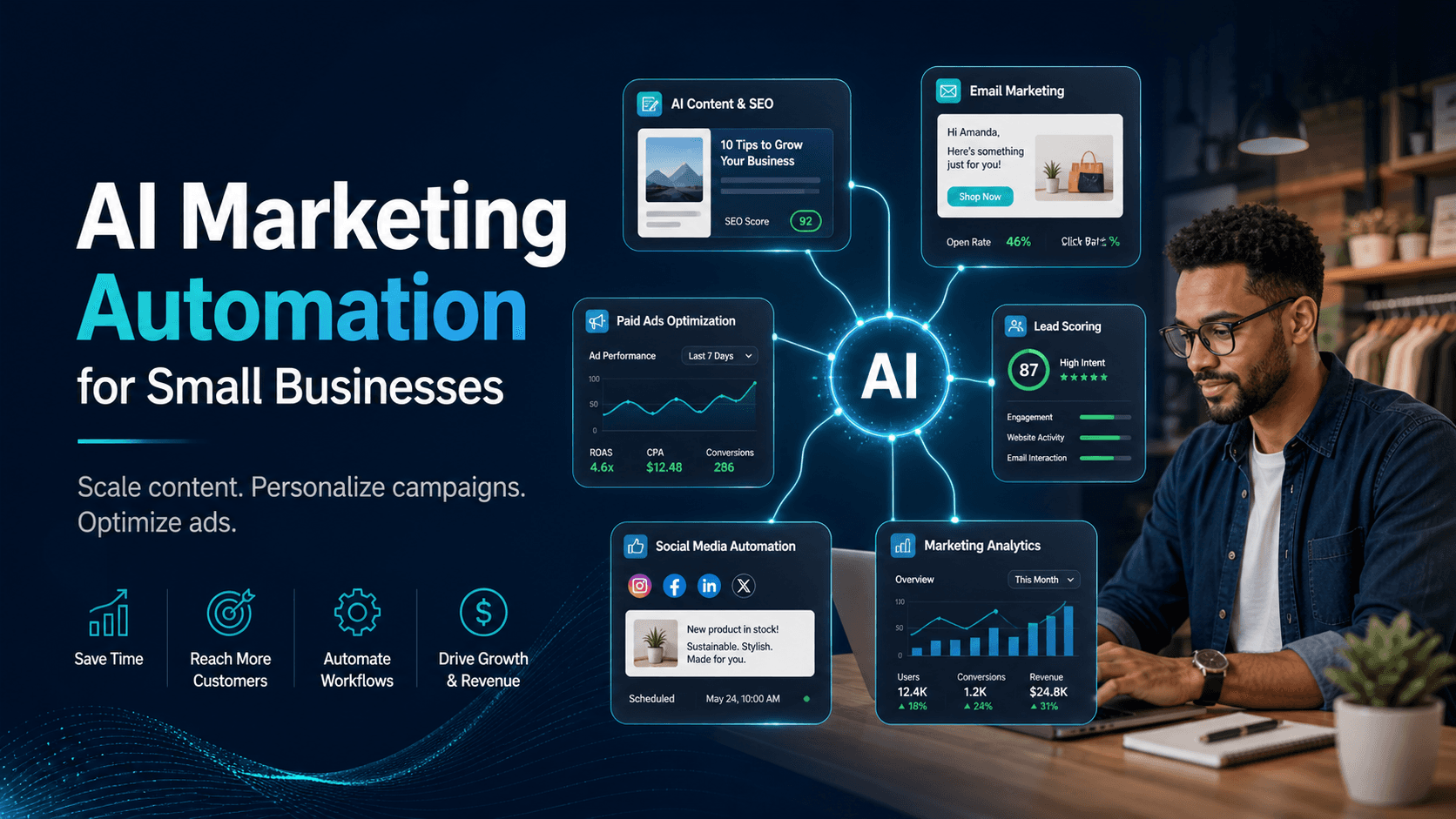
AI marketing automation uses large language models, predictive analytics, and machine learning to handle marketing tasks that used to require human judgment at every step. For an online store, it's not just scheduling a newsletter — it's generating product descriptions at catalog scale, writing personalized email and SMS copy per shopper, predicting who will buy or churn, and optimizing ad spend in real time.
For e-commerce and high-ticket brands, the impact is significant: you recover more abandoned-cart revenue, raise customer LTV, and measure more accurately without growing your marketing team. According to HubSpot's State of Marketing report, 71% of marketers say AI has made their content creation more efficient, and the top-performing teams are spending a growing share of their budget on AI-driven tooling.
Comprehensive AI Marketing Services for Online Stores
Six core service categories. We deliver them as standalone engagements or combine them into a full AI marketing stack tailored to your catalog, budget, and growth goals.
1. AI Product Content & SEO Strategy
Product descriptions, collection and category page copy, buyer guides, and ad creative — drafted by AI, refined by humans, tuned for your brand voice and target keywords. Includes a documented brand-voice playbook, prompt library, content briefs powered by Surfer SEO or Clearscope, and a publishing workflow that produces 5–10x more content across your full SKU catalog without sacrificing quality.
2. Email & SMS Lifecycle Marketing
Abandoned-cart, browse-abandon, post-purchase, replenishment, and win-back flows with AI-generated subject lines, dynamic product blocks per shopper, and send-time optimization. Built on Klaviyo, ActiveCampaign, Customer.io, or Mailchimp, with SMS via Postscript or Attentive. Typical lift: 2–3x in open and click-through rates.
3. AI-Powered Paid Ads & Performance Marketing
AI-generated product ad creative variants (10+ per campaign), automated bid strategies, catalog and shopping campaigns, lookalike expansion, Conversions API integration for clean signal, and budget reallocation based on real-time ROAS. Works across Meta Ads, Google Ads, and TikTok Ads. We focus relentlessly on lowering CAC and lifting ROAS, not just spending the budget.
4. AI Segmentation & Retention
Predictive models that segment every shopper by purchase behavior, AOV, and churn risk using signals from your store, ESP, and order history. High-LTV buyers get VIP and early-access campaigns. At-risk customers get win-back sequences. One-time buyers enter post-purchase nurture. See how this complements our AI chatbots for conversational shopper support.
5. AI Social Media & Brand Voice
AI-drafted posts for Instagram, TikTok, Pinterest, and Facebook scheduled at optimal times via Buffer, Hootsuite, or Later. Product launches and collections get repurposed into multi-platform content automatically. Comment monitoring and AI-suggested responses keep engagement responsive without burning your team out.
6. Marketing Analytics & Attribution Automation
Automated weekly and monthly reports combining ad spend, organic traffic, conversions, flow performance, and revenue per recipient. AI-driven insights that surface what's working without a data analyst. Multi-touch attribution across channels via Segment or native store tracking. End the era of dashboards that nobody reads.
How We Get Started: 3-Step Engagement Model
A predictable 8-week arc from kickoff to your first AI-powered campaign in production. No long planning phases. No vaporware decks.
Audit & Identify the Highest-Leverage Flow
We review your store funnel, conversion baseline, existing flows, and ad performance. We pick the one flow or channel where AI marketing will produce the fastest measurable lift — usually abandoned cart or post-purchase.
Build Brand Voice, Stack & First Flows
Document your brand voice, connect your store and ESP, build prompt libraries, and launch the first flows and campaigns against real shopper segments. We measure baselines before launch so the lift is provable.
Scale, Optimize, Add Channels
First flow is performing. Now we expand: add browse-abandon and win-back flows, layer in SMS and AI ad creative, automate reporting. Optional ongoing retainer keeps everything optimized as the AI landscape evolves.
Detailed AI Marketing Implementation Methodology (6 Phases)
For larger engagements we follow a six-phase delivery framework. Every phase has named deliverables, specific tools, and clear acceptance criteria so nothing surprises anyone.
| Phase | Timeline | Focus | Deliverable | Typical tools |
|---|---|---|---|---|
| 1. Marketing audit | Wks 1–2 | Store funnel review, baseline metrics, flow analysis | Audit report & opportunity ranking | GA4, Shopify, Hotjar, Looker |
| 2. Brand voice & data audit | Wks 2–3 | Documented voice, customer data hygiene, tracking review | Brand voice doc + data architecture | Klaviyo, Shopify, Segment, GTM |
| 3. AI stack setup | Wks 4–6 | Tool integrations, prompt libraries, product content templates | Working AI marketing stack | GPT-4, Claude, Surfer, Klaviyo, Make |
| 4. Pilot flows & campaigns | Wks 6–8 | First AI-driven flows and ad campaigns vs control | Live flows + lift report | Meta/Google Ads, Klaviyo, A/B tools |
| 5. Production rollout | Wks 9–12 | Multi-channel deployment, segmentation, automation | Full AI marketing system live | Klaviyo flows, Zapier, Postscript, Attentive |
| 6. Optimization & reporting | Ongoing | Performance tuning, attribution, monthly reviews | Live dashboards + monthly insights | Looker, GA4, Triple Whale, custom dashboards |
AI Marketing vs Traditional Marketing
Traditional marketing automation follows rules you define. AI marketing automation adapts. Here's how the two compare across the factors online stores care about most:
| Factor | Traditional marketing | AI-powered marketing |
|---|---|---|
| Content speed | Days to weeks per piece | Hours, with human review |
| Personalization | Segment-level, 3–5 groups | Individual-level, unlimited |
| A/B testing | Manual, 1–2 variants | Automated, 10+ variants |
| Reporting cadence | Weekly or monthly | Real-time dashboards |
| Cost per campaign | High (manual labor) | Lower (automated) |
| Scalability | Linear (add people) | Exponential (add AI) |
For a deeper breakdown, read our blog post on AI marketing vs traditional marketing for online stores.
Is Your Store Ready for AI Marketing Automation?
Before you invest in AI marketing tooling, it helps to know whether the foundations are in place. Here's a quick honest check.
Signs you're ready
- You have at least 500-1,000 email subscribers or past customers to segment against
- Your store and ESP have clean, structured data on orders and shoppers
- You can articulate your brand voice (or you're open to documenting it)
- You have consistent order volume and tracked conversion events
- You send marketing emails or run paid ads at least monthly
- You can dedicate 1-2 hours per week to reviewing AI-drafted output
Signs you're not ready yet
- Your email list is mostly bought, scraped, or hasn't been cleaned in 2+ years
- You don't track conversions or have purchase data flowing into your ESP
- Your catalog or positioning changes every week (AI scales noise too)
- Your store is brand-new with too few orders to learn from
- You don't have anyone available to review AI output before publishing
Want a deeper readiness check? Read Is Your Business Ready for AI?
AI Marketing Engagement Options & Pricing
Pricing depends on scope and how much of the marketing stack you need us to build. Here's the typical range for each engagement type:
| Engagement | Setup | Monthly | Best for |
|---|---|---|---|
| AI product content & SEO pipeline | $3K–$10K | $200–$800 | Catalog content & collection pages |
| Email & SMS lifecycle | $4K–$12K | $300–$1,200 | Abandoned-cart & retention flows |
| AI paid ads optimization | $4K–$10K | 10–15% of ad spend | DTC performance teams |
| Full AI marketing stack | $10K–$25K | $500–$2,000 | End-to-end store marketing system |
| Ongoing management retainer | — | $1,500–$7,500 | Continuous optimization |
Monthly platform costs (Klaviyo, SMS, ad spend, AI API usage) are separate and depend on your volume. Most high-ticket stores see positive ROI within 3–6 months. Final pricing comes after a free 30-minute discovery call — book it here.
AI Marketing Decision Framework for Online Stores
A handful of questions decide what kind of AI marketing investment makes sense. Here are the comparisons we run with every store during discovery.
AI content vs human content
| Use case | AI-drafted, human-edited | Human-only |
|---|---|---|
| Buyer guides & SEO collection copy | Best fit | Slow & expensive |
| Brand storytelling / founder voice | Limited | Best fit |
| Product descriptions at catalog scale | Best fit | Not viable past 100 SKUs |
| Email subject lines & A/B variants | Best fit | Limited variants |
| Original lookbooks / customer stories | Limited | Best fit |
| Product ad creative variants | Best fit (10+ variants/wk) | Bottleneck |
In-house marketer vs AI-augmented agency vs DIY tools
| Factor | DIY with AI tools | AI agency (us) | In-house marketer |
|---|---|---|---|
| Year 1 cost | $1K–$5K | $15K–$60K | $80K–$150K+ |
| Time to value | 3–6 months (steep curve) | 2–8 weeks | 3–6 months (after hire) |
| Strategic depth | Low | High (cross-client experience) | High (over time) |
| AI tooling expertise | You learn alone | Up to date by default | Depends on hire |
| Best for | Solo founders, very early stores | Growing & established online stores | Large multi-brand retailers |
Email automation vs AI marketing automation
| Capability | Standard email automation | AI marketing automation |
|---|---|---|
| Subject line writing | Manual, 1–2 variants | 10+ AI variants tested per send |
| Send-time targeting | Same time for everyone | Optimal time per shopper |
| Product recommendations | Same body for the segment | Dynamic blocks tailored per shopper |
| Shopper segmentation | Rule-based (basic) | ML model with purchase behavior + AOV |
| Cart & win-back recovery | Static drip | Behavior-adaptive flows |
| Reporting | Open/click rates | Revenue per recipient + AI insights |
AI Marketing for High-Ticket E-Commerce Store Types
AI marketing playbooks differ by what you sell. Below are the high-AOV, considered-purchase store types where we have deep experience — with the AI-marketing use cases that consistently produce ROI for premium online stores.
Long consideration windows mean nurture matters: AI-personalized browse-abandon and cart-recovery emails, room-and-style product recommendations, post-delivery upsell sequences. Stack: Shopify, Klaviyo, Postscript, Meta Ads, OpenAI.
High-AOV gifting buyers respond to white-glove copy: AI-segmented occasion and anniversary campaigns, AI-written product storytelling at SKU scale, VIP re-engagement flows tuned to lifetime value.
Education-driven buyers convert on the right content: AI-generated buyer guides and comparison copy, behavior-based replenishment and accessory upsell emails, seasonal campaign automation.
Spec-heavy catalogs need scale: AI-generated product descriptions and feature comparisons across SKUs, AI send-time and subject-line optimization, post-purchase warranty and accessory sequences.
Repeat-purchase economics reward lifecycle marketing: AI-driven replenishment reminders, review-mining for landing-page and ad copy, AI-personalized regimen and bundle recommendations.
Niche catalogs win on relevance: AI segmentation from first-party behavior, AI-generated content for category and collection pages, adaptive re-engagement flows for considered purchases.
AI Marketing Tools & Platforms We Build On
We're tool-agnostic. We pick the platforms that fit your existing stack, budget, and scale — not the ones that pay us commissions.
- OpenAI GPT-4 / GPT-4o
- Anthropic Claude
- Jasper
- Copy.ai
- Surfer SEO / Clearscope
- HubSpot Marketing Hub
- Klaviyo
- Customer.io
- ActiveCampaign
- Mailchimp
- Meta Ads Manager
- Google Ads
- TikTok Ads
- LinkedIn Ads
- Performance Max / Advantage+
- Buffer / Hootsuite / Later
- Attentive / Postscript (SMS)
- Podium / Birdeye (reviews)
- LinkedIn auto-tooling
- HubSpot / Salesforce / Pipedrive
- Segment
- Snowflake / BigQuery
- Airtable / Notion
- Zapier / Make / n8n
- GA4
- Mixpanel / Amplitude
- Looker Studio
- Hotjar / Microsoft Clarity
- Custom dashboards
Does AI Content Hurt SEO? What Google Actually Says
Short answer: no, if you do it right. Google's official position is that how content is produced doesn't matter — it's whether it's helpful, original, and demonstrates expertise. AI-assisted content that's fact-checked, edited by a human with domain knowledge, and adds unique insight performs well in search.
What doesn't work: auto-generated spam, content that rehashes what's already online, and keyword-stuffed “programmatic SEO” without real value. We never build that. Every piece of AI-assisted content we produce goes through a human expert for review, fact-checking, and voice alignment — consistent with Google's helpful content guidelines.
What You Get With an Ecorfy AI Marketing Engagement
- Marketing audit: Store funnel analysis, baseline metrics, and a ranked opportunity list before any work begins.
- Brand voice playbook: Documented tone words, vocabulary rules, banned phrases, and sample product copy encoded into reusable AI prompts.
- Product content system: Templates, prompt library, briefs, and review workflow capable of producing 5–10x your current catalog output.
- AI marketing stack: Tools selected, integrated, and configured for your specific store and platform — not a generic preset.
- Live flows & campaigns: First AI-driven abandoned-cart, post-purchase, or ad campaigns launched against measurable goals with provable lift over baseline.
- Segmentation & retention: Predictive models that segment shoppers by behavior and AOV and route them to the right flow.
- Attribution & reporting: Automated weekly/monthly reports combining all channels, plus AI-generated insights so you don't need a data analyst.
- Documentation & training: Your team learns how to operate the system. No black box, no consultant dependency.
- Optional ongoing optimization: Monthly retainer to keep flows and campaigns optimized as the AI landscape evolves.
Why E-commerce Brands Choose Ecorfy for AI Marketing
- E-commerce specialists. No enterprise bloat. We focus exclusively on online stores — high-ticket and high-AOV brands on Shopify, BigCommerce, WooCommerce, and custom storefronts.
- Brand voice first. AI is a multiplier — we lock in your voice before scaling product copy, so volume never comes at the cost of identity.
- Tool-agnostic. We don't resell Klaviyo, Shopify, or any platform. Our recommendations are based on what fits your store, not what pays us commissions.
- ROI-focused, not output-focused. We don't care how much content you publish. We care whether your CAC drops, your retention rises, and your revenue per shopper improves.
- End-to-end capability. Strategy, build, and ongoing management — all delivered by the same team that powers our AI chatbots, workflow automation, and AI consulting work.
- No lock-in contracts. Project-based or month-to-month. If you're not getting value, leave anytime.
AI Marketing Automation FAQs
What is AI marketing automation and how does it benefit an e-commerce store?
AI marketing automation uses artificial intelligence to generate product content, personalize lifecycle messaging, optimize ad creative, and surface insights at scale. For an online store, the benefit is recovering more revenue from abandoned-cart and browse-abandon flows, raising customer LTV with post-purchase and win-back sequences, and personalizing every touchpoint instead of broadcasting one email to your whole list.
How much does AI marketing automation cost for an online store?
Implementation projects typically range from $3,000 to $25,000 depending on catalog size and flow complexity. Ongoing platform costs (Klaviyo, SMS, AI APIs) run $200 to $2,000 per month. Monthly management retainers run $1,500 to $7,500. Most high-ticket stores see positive ROI within 3 to 6 months.
Will AI replace my marketing team?
No. AI handles repetitive, high-volume work (product copy, ad creative variants, segment building, reporting) so your team can focus on brand, merchandising, and strategy. The best e-commerce teams use AI to do 5–10x more work with the same headcount.
Can AI-generated product content hurt my SEO?
No, as long as the content is useful, original, and edited by a human. Google judges content by helpfulness, not how it was produced. AI-assisted product descriptions and collection pages that add real insight rank well; AI spam does not. We never publish unedited AI output.
How long until I see results?
Abandoned-cart flows and paid ads optimization typically show measurable lift in 2–4 weeks. SEO content for collection and category pages takes 3–6 months to rank and drive traffic. Most stores see meaningful improvements in recovered revenue and conversion rate within the first 90 days.
AI product copy vs human-written copy: which performs better?
Hybrid wins. AI drafts product descriptions and ad variants faster and covers your full catalog — but humans add brand voice, merchandising judgment, and credibility. We use AI to produce drafts and variants at scale, then a human reviews, fact-checks, and adds proprietary perspective before anything ships.
How do you measure AI marketing ROI for an online store?
We track three layers: input (product content shipped, flows live, ad creative tested), engagement (open rate, CTR, add-to-cart rate, flow conversion), and outcome (revenue per recipient, recovered cart revenue, CAC, customer LTV, attributed revenue). Every engagement starts with baseline metrics so the lift is provable.
Won’t AI make our store sound generic?
Only if you let it. We build a documented brand voice (tone words, vocabulary rules, banned phrases, sample product copy), encode it into prompts and style guides, and review every published piece. Generic AI output comes from generic prompts, not from AI itself.
How do you handle customer data privacy in AI marketing?
We use enterprise-grade providers (OpenAI Enterprise, Azure OpenAI, Anthropic Enterprise) that don’t train on your data, comply with GDPR/CCPA for shopper data flows, configure access controls on your store and ESP, and avoid pushing PII through general-purpose tools when an enterprise option exists.
Can I start with one flow before doing everything?
Yes — we strongly recommend it. Most stores start with the highest-leverage flow (usually abandoned cart or post-purchase) for the first 60 days, prove ROI, then layer in browse-abandon, win-back, and ad creation. Trying to launch every channel simultaneously is the most common failure mode.
What tools do you use for AI marketing automation?
We use Klaviyo, Postscript, Attentive, Shopify, BigCommerce, WooCommerce, Meta Ads Manager, Google Ads, TikTok Ads, GPT-4, Claude, Jasper, Surfer SEO, Clearscope, and custom RAG pipelines depending on your stack.
Personalized email vs batch-and-blast: what actually changes?
Batch-and-blast sends one email to your whole list. Personalized AI email and SMS generate the subject line, body content, send time, and product recommendations per shopper based on browse and purchase history, segment, and AOV. Expect 2–3x lift in open and click-through rates plus a meaningful drop in unsubscribes.
Do you resell AI marketing platforms or take vendor commissions?
No. We have no affiliate or reseller relationships with Klaviyo, Shopify, or any marketing platform. Our recommendations are based on fit with your store and budget — not on commissions or rev share.
Related Reading on AI Marketing
Ready to Make Marketing a Compounding Revenue Engine?
Book a free 30-minute consultation. We'll spend the time understanding your store, mapping where AI marketing could realistically lift revenue, and giving you an honest answer — even if that answer is “not yet.”
- Run an e-commerce or high-ticket online store with a lean marketing team
- Need to produce more product content, emails, and ad creative without hiring
- Feel your email, SMS, and ad performance has plateaued
- Have shopper and order data sitting unused in your store or ESP
- Want to personalize every touchpoint by purchase behavior, not broad segments