AI Integration for E-commerce & High-Ticket Online Stores
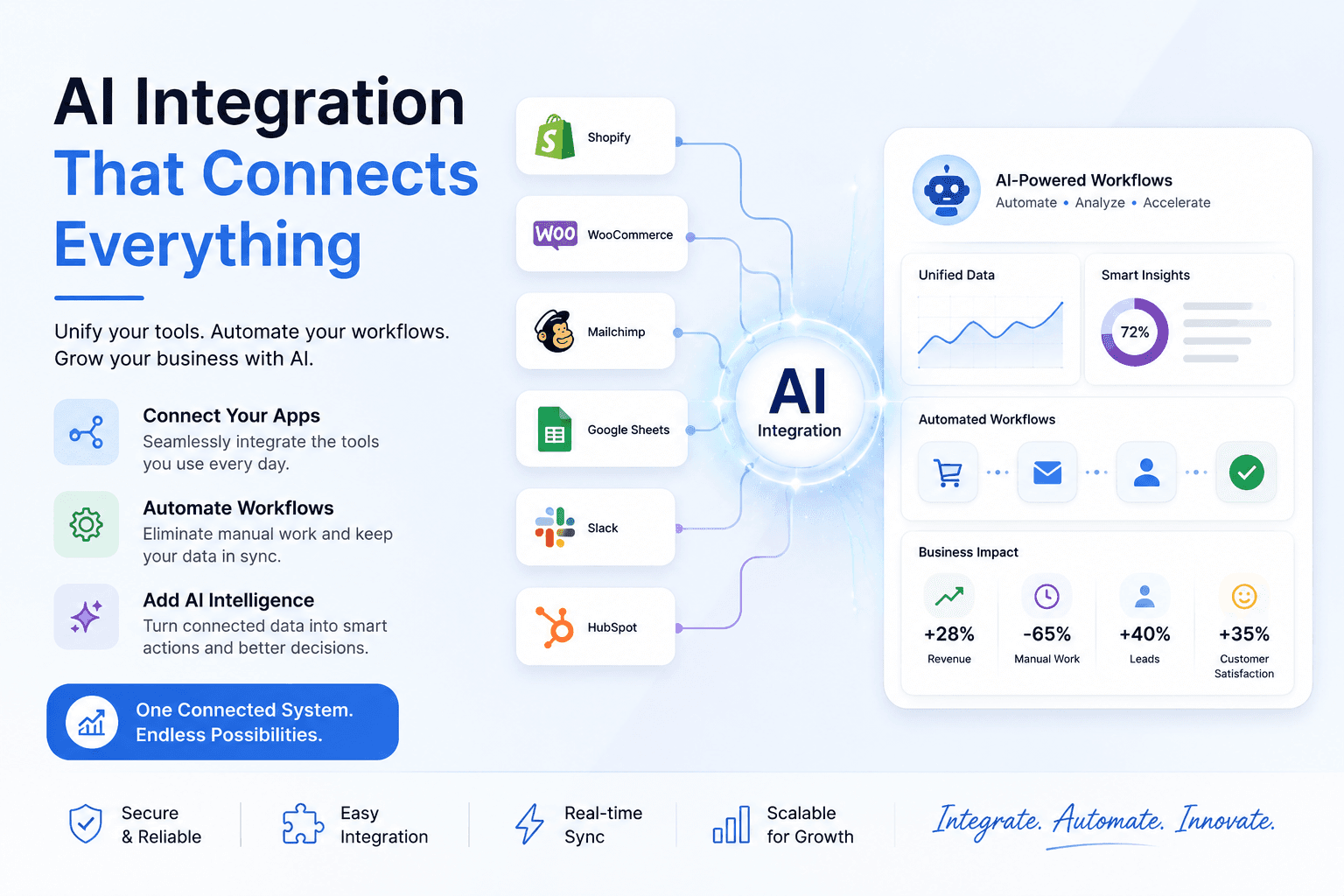
Ecorfy builds AI integration systems that embed large language models, AI agents, and retrieval-augmented generation directly into the store stack your e-commerce brand already runs — Shopify, BigCommerce, WooCommerce, your product catalog and PIM, ERP, helpdesk, CRM, OMS. We handle the API integration, catalog and order-data plumbing, guardrails, observability, and governance so AI becomes a real layer of your store operations, not a separate chat window nobody opens. AI-integrated systems that are production-ready, cost-controlled, and measurably valuable.
Single-integration time to production
Vendor-agnostic — no commissions
Observability + cost guardrails included
Where Most AI Integration Projects Quietly Break Down
Standing up a chatbot in a sandbox is easy. Integrating AI into the store systems your e-commerce brand actually runs on is where most projects collapse. These are the six failure patterns we see most often.
“Our team uses ChatGPT but it never sees our catalog.”
Without retrieval over your product catalog, store policies, or order data, AI is a generic assistant. The value comes from grounding answers in your actual store systems.
“The AI feature in our Shopify app has 5% adoption.”
Off-the-shelf store-app AI features that aren't configured for your specific workflows feel generic and rarely stick. Custom integration into your real store processes is what drives adoption.
“Our pilot worked. The integration broke our store workflows.”
A great pilot in isolation often falls apart in production: edge cases, latency, error handling, and integration with adjacent store tools all need design from day one.
“We can't commit because vendor lock-in scares us.”
A model-agnostic architecture with provider abstraction (OpenAI, Anthropic, Google interchangeable) protects against pricing changes and outages. Most integrations skip this.
“Compliance blocked the integration over data residency.”
If sensitive data flows through general-purpose LLM endpoints without proper enterprise contracts and BAAs, security review will (correctly) stop it. Architecture choices matter.
“Token costs spiraled because nobody set guardrails.”
Without max-token budgets, model routing, and caching, a single recursive bug or pathological input can spend hundreds of dollars in minutes. We've seen it firsthand.
Done right, AI integration fixes all six. We treat AI integration like the production systems engineering project it actually is — not a vendor demo.
What Is AI Integration for E-commerce?
AI integration for e-commerce is the practice of connecting AI capabilities — large language models, AI agents, retrieval-augmented generation, embeddings — to the store systems your brand already uses. The goal is to make AI useful in your actual store workflows: a merchandiser gets AI-drafted product copy inside Shopify Admin, a support agent sees AI-summarized order history in their helpdesk, an ops manager queries catalog and order data in plain English.
Concretely, an AI integration project typically involves four ingredients: (1) one or more foundation models accessed via API (GPT-4, Claude, Gemini, or self-hosted open-source), (2) a retrieval layer over your store data — product specs, store policies, catalog and PIM records, (3) integration glue connecting the AI to your store stack through REST APIs, webhooks, or the Model Context Protocol (MCP), and (4) production infrastructure for guardrails, observability, and cost control.
Most e-commerce brands and high-ticket online stores can capture the majority of AI's value through integration alone — without ever training a custom model. According to McKinsey's State of AI research, organizations capturing measurable value from AI tend to be those treating it as an integration discipline embedded across functions, not as a side project.
AI Integration vs Custom AI Development vs Off-the-Shelf AI Features
Three different approaches to bringing AI into your store. Most e-commerce brands and high-ticket online stores should focus on integration. Here's how they compare:
| Factor | Off-the-shelf AI features | AI integration (this page) | Custom AI development |
|---|---|---|---|
| Setup cost | Free / part of SaaS | $5K–$200K | $100K–$2M+ |
| Time to value | Immediate | 4–12 weeks | 6–18 months |
| Tailored to your data | Generic | Yes (via RAG) | Yes (training) |
| Connects to your systems | Limited | Full integration | Full custom |
| Vendor lock-in risk | High | Manageable (model abstraction) | Low |
| Best for | Quick experimentation | Most e-commerce brands & high-ticket stores | Marketplaces, AI-first commerce products |
The right answer for most stores: start with off-the-shelf store-app features to validate use cases, move to integration once a workflow proves valuable, and only consider custom development when integration economics no longer work.
Comprehensive AI Integration Services for Online Stores
Six core service categories. Each can be delivered standalone or combined into a multi-system integration program tailored to your store operations.
1. AI Integration Strategy & Architecture
Map your current store stack, identify the highest-ROI integration opportunities, and design an architecture that avoids vendor lock-in. Includes provider selection (OpenAI vs Anthropic vs Google vs self-hosted), abstraction layer design, and a phased rollout plan. We are happy to tell you when AI integration is the wrong answer and a simpler approach — like our workflow automation service — would deliver more value.
2. LLM API Integration & Provider Abstraction
Production integration with OpenAI, Anthropic, Google Gemini, Azure OpenAI, and AWS Bedrock. We build a thin abstraction layer so you can switch providers, run A/B tests across models, and route different request classes — bulk catalog jobs vs live shopper queries — to different price tiers. Streaming, retries, fallback chains, and rate-limit handling included by default.
3. RAG (Retrieval-Augmented Generation) Systems
Connect AI to your real store data through retrieval. We design the chunking strategy, embedding pipeline, vector store (Pinecone, Weaviate, Chroma, or Supabase pgvector), and re-ranking over your product specs, sizing and compatibility docs, and store policies. RAG is the right starting point for almost every catalog, product-data, or policy integration — faster than fine-tuning, cheaper to maintain, easier to update as SKUs change.
4. AI Agent & MCP Server Development
When AI needs to take actions, not just answer questions. We build production AI agents using OpenAI Agents SDK, Claude Agent SDK, LangGraph, or custom code, plus reusable Model Context Protocol (MCP) servers connecting agents to your store systems — Shopify Admin, PIM, ERP, OMS. See our agentic AI development service for deeper coverage.
5. Store Stack AI Integration
Embed AI into the tools your store team already uses: Shopify, BigCommerce, WooCommerce, Gorgias, Zendesk, Intercom, Klaviyo, your ERP, PIM, and OMS. We handle the auth, webhooks, rate limits, and event handling so AI shows up where store work happens — not in a separate window.
6. AI Integration Operations & Governance
Production AI needs maintenance: prompt drift correction, model upgrades, cost optimization, security review, incident response. Aligned with the NIST AI Risk Management Framework, our governance setup includes audit logging, human approval gates on consequential actions, data residency controls, and access policies. Optional ongoing retainer for monitoring and tuning.
How We Get Started: 3-Step Engagement Model
A predictable arc from kickoff to a production AI integration. No multi-quarter slideware projects.
Audit Systems & Pick the Right Integration
Map your current stack, score integration opportunities by ROI and feasibility, define success metrics, and choose one initial integration. You get a clear plan even if you don't continue.
Build the Integration with Guardrails
Build the LLM layer, RAG pipeline, integration glue, observability, and cost guardrails. Validate against real data and edge cases. Ships with a runbook, not a slide deck.
Production Rollout & Operate
Deploy with monitoring and human oversight. Train your team. Measure lift against baseline. Optional ongoing operations retainer for long-term maintenance and tuning.
Detailed AI Integration Methodology (6 Phases)
For larger engagements we follow a six-phase delivery framework. Every phase has named deliverables, specific tools, and clear acceptance criteria.
| Phase | Timeline | Focus | Deliverable | Typical tools |
|---|---|---|---|---|
| 1. Discovery & audit | Wks 1–2 | System map, integration ROI ranking | Integration brief | Workflow interviews |
| 2. Architecture | Wks 2–3 | Provider selection, abstraction design | Architecture document | Mermaid, OpenAPI, MCP spec |
| 3. Data & RAG layer | Wks 3–5 | Embedding pipeline, retrieval, re-ranking | Working RAG pipeline | Pinecone, Weaviate, Chroma, LlamaIndex |
| 4. Integration build | Wks 5–7 | LLM provider, app integrations, MCP servers | Functional integration | OpenAI, Claude, Gemini, FastAPI, Next.js |
| 5. Hardening | Wks 7–9 | Guardrails, observability, edge cases, red-teaming | Production-ready integration | LangSmith, Helicone, LangFuse, Arize |
| 6. Operate & tune | Ongoing | Monitoring, prompt drift, model upgrades | Runbook + monthly reports | Custom dashboards, on-call alerts |
AI Integration Use Cases by E-Commerce Store Type
Real integrations that produce measurable ROI for high-ticket online stores. The pattern matters — LLMs, RAG, and MCP connected to the store systems you already run, not standing apart from them.
LLMs wired into Shopify Admin and your ERP: AI-generated room-and-dimension product copy at SKU scale, RAG over delivery and assembly docs surfaced in support tickets, AI freight-status summaries. Common stack: Shopify Admin API, MCP servers, OpenAI / Claude.
RAG over authentication, materials, and care documentation connected to your helpdesk; AI-summarized VIP customer history surfaced for concierge teams; AI-drafted personalized outreach.
MCP tools connecting product specs, inventory, and shipping systems so an LLM can answer fit and compatibility questions; AI-generated buyer guides synced from your catalog data.
RAG over spec sheets, firmware notes, and warranty terms connected to support; AI feature-comparison copy generated across SKUs; LLM-summarized customer history inside every ticket.
LLMs integrated with subscription and order systems: AI-personalized regimen recommendations, RAG over ingredient and usage docs, AI-drafted replenishment and review-response messages.
RAG over a focused catalog and policy docs connected to your storefront and helpdesk; MCP integrations to inventory and supplier systems; AI-summarized customer history for support.
Is Your Store Ready for AI Integration?
AI integration delivers compounding value — but only if your foundations are in place. A quick honest check below, or take our full 50-point readiness checklist for a complete score.
Signs you're ready
- You have at least one high-volume store workflow worth integrating AI into
- Your data lives in API-friendly tools (Shopify/BigCommerce/WooCommerce, PIM, helpdesk, ERP)
- You can articulate measurable success criteria for the integration
- You have a budget for ongoing token spend (not just one-time setup)
- You can dedicate someone on your team to review AI output during early production
- You're willing to start narrow before scaling
Signs you're not ready yet
- Your catalog and order data is locked in legacy systems with no APIs
- Your store processes change every week (AI integration needs stable inputs)
- You can't define what success looks like
- You expect AI to fix a fundamentally broken store or unit economics
- You have no appetite for human-in-the-loop in early production
AI Integration Engagement Options & Pricing
Start narrow, prove ROI, then expand. Five engagement tiers covering everything from a 1-week scoping sprint to a multi-quarter platform engagement.
| Engagement | Duration | Typical cost | Best for |
|---|---|---|---|
| Discovery sprint | 1 week | $1.5K–$3K | Validating fit before investing |
| Single AI integration | 4–8 weeks | $5K–$15K | One workflow, one app |
| Multi-system integration | 2–4 months | $15K–$50K | 3+ systems, central observability |
| Enterprise integration platform | 3–6 months | $50K–$200K+ | LLM gateway, RAG infra, governance |
| Operations retainer | Monthly | $2K–$10K/mo | Ongoing tuning & incident response |
Token spend (model usage in production) is billed at cost — no markup. Final pricing depends on number of systems, integration complexity, and SLA requirements. Book a free call for a fixed-fee quote.
AI Integration Decision Framework
Three decisions every AI integration project has to make. We work through these with every store during discovery.
RAG vs fine-tuning vs prompt engineering
| Factor | Prompt engineering | RAG | Fine-tuning |
|---|---|---|---|
| Setup speed | Hours to days | Days to weeks | Weeks to months |
| Cost | Lowest | Low to moderate | Higher (training compute) |
| Best for | Generic tasks, simple format | Grounding in your catalog & policies | Specific brand tone/format/jargon |
| Updating knowledge | N/A (no knowledge stored) | Just re-index when SKUs change | Re-train |
| Right answer for online stores | Validate first | Almost always start here | Rare at this stage |
OpenAI vs Anthropic vs Google vs self-hosted
| Provider | Strengths | Best for |
|---|---|---|
| OpenAI (GPT-4o, o-series) | Broad capability, mature ecosystem, Assistants API | Most general-purpose work |
| Anthropic (Claude) | Long context, instruction following, tool use, MCP-native | Detailed product specs, complex catalog reasoning |
| Google (Gemini) | Multimodal, GCP / Workspace integration | Product-image use cases, Google-native stores |
| Azure OpenAI / AWS Bedrock | Enterprise contracts, regional deployment, compliance | Large retailers, existing AWS/Azure store infra |
| Self-hosted (Llama, Mistral) | Data never leaves your network, no per-token cost | High-volume catalog jobs, sensitive order data, full control |
Build in-house vs hire integration agency vs use no-code AI tools
| Factor | No-code AI tools | Integration agency (us) | In-house engineering team |
|---|---|---|---|
| Year 1 cost | $200–$2K/mo | $15K–$80K | $200K–$400K+ |
| Time to first integration | Days (limited scope) | 4–10 weeks | 3–6 months after hire |
| Custom integrations | Limited | Full | Full |
| Observability & governance | Basic | Production-grade | Depends on team |
| Best for | Quick experiments | Most growing e-commerce brands | Large retailers with dedicated engineering |
Tools, Frameworks & Protocols We Build On
We are vendor-agnostic. We pick the right tool for your store's scale, integration complexity, and team capability.
- OpenAI (GPT-4o, o-series)
- Anthropic Claude
- Google Gemini
- Azure OpenAI
- AWS Bedrock
- Self-hosted: Llama, Mistral
- Shopify Admin / BigCommerce / WooCommerce APIs
- Model Context Protocol (MCP)
- REST APIs / GraphQL
- Webhooks & event streams
- Make / n8n / Pipedream
- Pinecone
- Weaviate
- Chroma
- Supabase pgvector
- LangChain / LlamaIndex
- OpenAI Agents SDK
- Anthropic Claude Agent SDK
- LangChain / LangGraph
- Microsoft Semantic Kernel
- Vercel AI SDK
- Clerk / Auth0 / Supabase Auth
- OAuth 2.0 / OIDC
- JWT & signed webhooks
- API key rotation & scoping
- LangSmith
- Helicone
- LangFuse
- Arize / Phoenix
- Datadog / Sentry
What You Get With an Ecorfy AI Integration Engagement
- Integration architecture document: Provider selection, abstraction layer design, data flow diagrams, and failure-mode analysis.
- Working production integration: Deployed, monitored, and integrated into your store stack — not a Jupyter notebook demo.
- RAG pipeline (when in scope): Embedding strategy, vector store, retrieval, re-ranking over your catalog and policies, and a re-index workflow for SKU changes.
- Provider abstraction layer: Switch LLM providers without rewriting application code.
- Cost guardrails & dashboards: Per-feature cost tracking, max-token budgets, model routing, alerts on threshold breach.
- Observability stack: Structured tracing of every prompt, retrieval, and tool call — you see exactly what happened and why.
- Evaluation harness: Test cases that measure success rate, latency, cost, and quality on representative inputs.
- Operations runbook: Documented procedures for incident response, prompt updates, model upgrades, and provider failover.
- Team training: Your team learns how the integration works and how to operate it. No black box.
- Optional ongoing operations: Monthly retainer for monitoring, tuning, and incident response.
Why E-commerce Brands Choose Ecorfy for AI Integration
- We treat store integrations as production systems. Observability, guardrails, evaluation harnesses, and runbooks are non-negotiable, not optional.
- Provider-agnostic by design. No reseller relationships with OpenAI, Anthropic, Google, or anyone else. We pick the right model for your problem — not whichever vendor pays a commission.
- Honest about when integration is wrong. If a workflow doesn't need AI, we'll tell you and recommend workflow automation instead. If you need autonomous agents, we'll point you to agentic AI.
- End-to-end capability. Strategy through production through ongoing operations — same team that delivers our AI chatbots, AI marketing automation, and AI commerce engagements.
- Cost-aware. Token spend is real money. We design with cost dashboards and hard limits from day one, not after the first surprise bill.
- No lock-in. Project-based or month-to-month. We hand off documentation and runbooks so your team can take over whenever you want.
AI Integration FAQs
What is AI integration for e-commerce?
AI integration for e-commerce is the practice of connecting AI capabilities — large language models, AI agents, retrieval-augmented generation — to the store systems your brand already uses, such as Shopify, BigCommerce or WooCommerce, your PIM, ERP, helpdesk, CRM, and OMS. The goal is to make AI useful in your actual store workflows rather than as a separate chat window.
How is AI integration different from custom AI development?
Custom AI development typically builds new AI capabilities from scratch (training models, building agents). AI integration focuses on connecting existing best-in-class AI services (OpenAI, Anthropic, Google) to your existing store stack. For most e-commerce brands and high-ticket online stores, integration is the right starting point.
How much does AI integration cost?
A discovery sprint runs $1.5K–$3K. A single production AI integration runs $5K–$15K. Multi-system integrations across your store tools run $15K–$50K. Enterprise integration platforms run $50K–$200K+. Operations retainers run $2K–$10K/month. Token spend is billed at cost.
How long does AI integration take?
Discovery sprint: 1 week. Single integration: 4–8 weeks. Multi-system: 2–4 months. Enterprise platform: 3–6 months. Most engagements include a working pilot in the first 4–6 weeks.
Which AI provider should we use — OpenAI, Anthropic, or Google?
Depends on workload. OpenAI is broadly capable with a mature ecosystem. Anthropic Claude excels at long-context reasoning and tool use — useful for grounding on detailed product specs. Google Gemini is strong on multimodal and Google Cloud integration. We typically use a primary model and a fallback from a different provider to avoid single-vendor risk.
What is MCP and should we use it?
MCP (Model Context Protocol) is an open standard introduced by Anthropic in November 2024 for connecting AI assistants to data sources and tools. It standardizes how AI models access your store systems — Shopify Admin, PIM, ERP, OMS, helpdesk — through reusable "MCP servers." Worth investing in if you use Claude or any MCP-compatible client.
RAG vs fine-tuning: which does my store need?
For almost all e-commerce brands, RAG is the right choice. RAG grounds AI responses in your actual product catalog, specs, and store policies — fast to set up, easy to update when SKUs change, no model training required. Fine-tuning makes sense only when you need consistent brand tone or format that prompts can't enforce.
Should we use cloud LLMs or self-host?
Cloud LLMs are the right default. Self-hosted open-source models make sense for highly sensitive customer or order data, very high-volume catalog workloads where token cost dominates, or strict regulatory requirements where you need full control over inference.
How do you keep AI integration costs under control?
Cost guardrails from day one: max-token budgets per request, tool-call depth limits, model-tier routing, aggressive caching of repeated catalog queries, cost dashboards with alerting. We stress-test pathological inputs before deployment.
How do you handle data privacy and compliance?
Enterprise-grade providers (OpenAI Enterprise, Anthropic Enterprise, Azure OpenAI, AWS Bedrock) that don't train on your data, and align deployments with SOC 2 and PCI requirements as applicable to customer and order data. NIST AI RMF compliance.
What are the most common AI integration failures?
Six failure modes: (1) AI without grounding in your real catalog and order data; (2) no observability or audit trail; (3) no cost guardrails; (4) no integration with store systems; (5) no human-in-the-loop on consequential actions like refunds; (6) no measurement of ROI.
What ROI should I expect from AI integration?
10–30 hours per week of recovered team time, 2–3x faster customer response times in your helpdesk, 20–40% reduction in cost per support ticket. Specific results depend on your starting point. Every engagement starts with baseline metrics.
Can we start with one use case before committing?
Yes — strongly recommended. Most stores start with a 1-week discovery sprint or single-integration engagement. Only after that integration is in production with measurable ROI do we recommend expanding.
Related Reading
Ready to Make AI Part of Your Real Store Operations?
Book a free 30-minute consultation. We'll spend the time understanding your store stack, identifying where AI integration could realistically help, and giving you an honest answer — even if that answer is “workflow automation alone is enough for now.”
- Have catalog and order data locked up in tools you can't easily query
- Want AI that's grounded in your real product catalog, not generic
- Need to integrate AI with Shopify, your PIM, ERP, helpdesk, or OMS
- Care about observability, governance, and cost control
- Want a vendor-agnostic approach that won't lock you in