AI Consulting for E-commerce & High-Ticket Online Stores
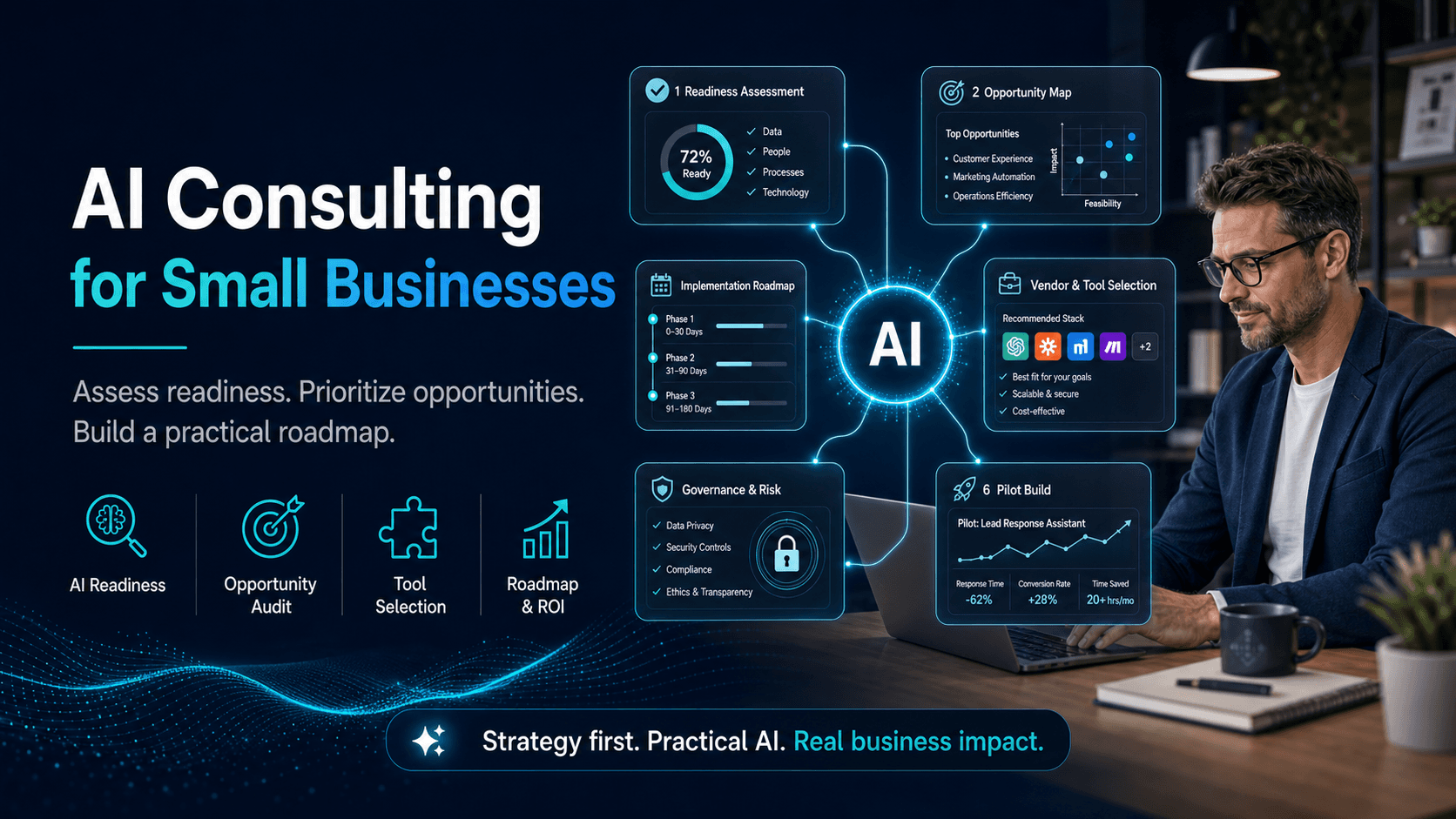
Ecorfy provides AI consulting for e-commerce brands and high-ticket online stores that want to adopt AI without enterprise budgets or consulting-firm overhead. Our engagements start with an AI readiness assessment, move to a ranked list of opportunities to lift conversion rate, AOV, and customer LTV, and finish with a practical implementation roadmap your team can actually execute. Tool-agnostic, ROI-focused, plain language — no jargon-heavy strategy decks and no long-term lock-in.
Typical strategy engagement
Tool-agnostic, no vendor commissions
Long-term lock-in contracts
Where Most E-Commerce AI Projects Quietly Break Down
AI looks easy in demos. The store founders and e-commerce operators we talk to keep telling us the same six stories about what actually happens when they try to adopt it without a plan:
“We hired a freelancer who built something nobody uses.”
A custom AI tool was delivered, the freelancer left, and now no one on your team knows how it works or how to fix it when it breaks.
“Our team tried ChatGPT but couldn't make it stick.”
It feels useful in isolation but never connects to your catalog, order history, or helpdesk — so it never delivers compounding value.
“We bought an AI app but adoption stalled at 10%.”
Installing the app was the easy part. Without training, change management, and clear playbooks, your team reverts to old habits.
“Our support team is drowning, but enterprise AI pricing is impossible.”
Every vendor pitch starts at $50K minimum. You need real automation but cannot justify Fortune 500 budgets.
“Competitors say they use AI. We don't know what's real.”
It is hard to tell hype from substance. You need an honest read on which AI claims actually move store metrics and which are LinkedIn theater.
“We ran a pilot. It worked. Then nothing happened.”
Pilots prove the technology works. The hard part is operationalizing it — storefront integrations, monitoring, governance, training — and that is where projects die.
AI consulting solves all six. It puts the store problem first, the tool second, and adoption above everything.
What Is AI Consulting for E-commerce Brands?
AI consulting helps an online store figure out where artificial intelligence can create real value — and how to implement it effectively. A good AI consultant for e-commerce brands does three things: (1) assesses your store's current state honestly, (2) identifies opportunities ranked by impact on conversion rate, AOV, and LTV and by feasibility, and (3) builds a concrete plan to get from here to there. No jargon. No tool bias. No recommendations that require you to re-platform everything you already have.
The stakes are high. McKinsey's State of AI research shows that organizations using AI now report measurable cost reductions and revenue gains, but the gap between high-performing adopters and everyone else is widening. Good consulting is what moves your store from “interested in AI” to “deploying AI that pays for itself.”
Comprehensive AI Consulting Services for Online Stores
Six core consulting services. We deliver them as standalone engagements or combine them into a full AI transformation program tailored to your store's scale, budget, and risk tolerance.
1. AI Strategy & Roadmap
A store-aligned plan that identifies the highest-ROI opportunities, ranks them by feasibility and impact on conversion rate, AOV, and LTV, and sequences them into a roadmap with concrete milestones. Includes AI readiness assessment, opportunity mapping, and prioritizing storefront vs. back-office AI investments across 12-24 months with budget projections, success metrics, and risk mitigation.
2. Generative AI & LLM Solutions Strategy
Strategic guidance on where large language models actually deliver value for a store — not where they sound impressive. Covers retrieval-augmented generation (RAG) systems, support chatbots, intelligent agents, product content generation, and custom GenAI applications grounded in your catalog and order data. We help you choose between off-the-shelf storefront apps and custom builds.
3. Workflow & Process Automation Consulting
Identify the highest-leverage store workflows to automate first — order processing, returns and exchanges, inventory updates, post-purchase support, marketing reporting — and choose the right platform (Zapier, Make, n8n, native Shopify Flow, or custom). Includes ROI estimates, implementation effort, and integration paths. See our workflow automation service for build-and-deliver work.
4. Vendor & Tool Selection for Your Store Stack
Independent evaluation of AI tools against your specific store requirements, budget, and existing stack. We benchmark options across LLM providers, vector databases, automation platforms, AI-native e-commerce apps, and analytics tools — and tell you what to buy, what to skip, and where to negotiate. We have no affiliate or reseller relationships with vendors.
5. AI Governance, Privacy & Risk Management
Responsible-AI policy and compliance frameworks aligned with the NIST AI Risk Management Framework. Covers customer data privacy, model selection, human oversight, audit trails, and e-commerce requirements (PCI, SOC 2, GDPR/CCPA). Critical for stores handling payment and personal data at scale.
6. Fractional AI Leadership & Change Management
Ongoing executive-level AI strategy support without the cost of a full-time Chief AI Officer. Includes weekly check-ins, vendor reviews, training programs, internal documentation, adoption playbooks, and change-management support so the AI tools your store buys actually get used. Typical commitment: 8-20 hours per month.
How We Get Started: 3-Step Engagement Model
Most consulting engagements follow this fast, predictable arc. From kickoff to a working pilot in roughly two months.
Identify Your Highest-Impact Use Cases
We map your store's workflows, review storefront and analytics data, interview your team, and identify 2-3 priority AI opportunities with a concrete build plan. You walk away with a ranked roadmap whether or not you continue.
Build & Test a Working Pilot
We develop against your real catalog and order data, test in a staging storefront, and validate with your team before any integration. The pilot proves impact on store metrics, not just technical feasibility.
Deploy & Scale to Production
System integration, team training, and adoption support during rollout. We hand off documentation and stay on retainer for ongoing optimization if you want.
Detailed AI Implementation Methodology (6 Phases)
For larger engagements we follow a six-phase delivery framework. Every phase has named deliverables, specific tools, and clear acceptance criteria so nothing surprises anyone.
| Phase | Timeline | Focus | Deliverable | Typical tools |
|---|---|---|---|---|
| 1. Discovery | Wks 1–2 | Store workflow mapping, opportunity ranking | AI ROI Blueprint | Interviews, store ops review |
| 2. Data & tools audit | Wks 2–3 | Catalog/order data readiness, integration paths | Store-stack architecture doc | Shopify, BigCommerce, Klaviyo, GA4 |
| 3. Pipeline / RAG setup | Wks 4–6 | Data ingestion, embeddings, retrieval | Working data pipelines | Pinecone, Weaviate, Chroma, LangChain |
| 4. Pilot build & validation | Wks 6–8 | Sandboxed prototype, edge cases | Functional pilot / MVP | OpenAI GPT-4, Claude, Voiceflow |
| 5. Production deployment | Wks 9–12 | Integrations, monitoring, training | Live workflows + adoption playbook | Zapier, Make, n8n, custom APIs |
| 6. Optimization & handoff | Ongoing | Tuning, monitoring, retraining | Documentation + support runbook | Helicone, LangSmith, internal dashboards |
Is Your Online Store Ready for AI?
Before you invest in AI consulting or implementation, it helps to know where your store actually stands. Here's a quick honest check — or take our full 50-point AI automation readiness checklist for a complete score.
Signs you're ready
- Team spending 10+ hours per week on repetitive store tasks
- Running on a modern platform (Shopify, BigCommerce, WooCommerce, custom)
- Clean, consistent product, order, and customer data
- Customer support response times are slower than you'd like
- Order volume is growing but you don't want to hire proportionally
- Budget for technology investments, even modest
Signs you're not ready yet
- Catalog and order data is messy, scattered, or inconsistent (clean up first)
- No standardized fulfillment or support processes (AI needs consistent inputs)
- Team is resistant to all tech change (culture first)
- No clear store problem to solve (AI needs a target metric)
- Still figuring out product-market fit
Want a deeper self-assessment? Read our blog post, Is Your Business Ready for AI?
AI Consulting Engagement Options & Pricing
We structure engagements around your store's actual needs and risk tolerance. Start small, prove ROI on real store metrics, then expand — or commit to a full transformation program. Here's the typical range for each option:
| Engagement | Duration | Typical cost | Best for |
|---|---|---|---|
| Discovery sprint | 1 week | $1.5K–$3K | Validating fit before investing further |
| AI readiness assessment | 2–4 weeks | $3K–$7K | First-time AI evaluation |
| Opportunity audit + roadmap | 4–8 weeks | $8K–$20K | Stores with a plan to invest |
| Full transformation program | 3–12 months | $20K–$100K+ | Multi-phase AI deployment |
| Fractional AI leadership | Monthly retainer | $2K–$7.5K/mo | Ongoing strategic guidance |
Final pricing depends on scope, catalog size, and data complexity. We provide a fixed-fee quote after a free 30-minute discovery call — book it here.
AI Decision Framework for E-commerce Operators
A handful of questions decide what kind of AI investment makes sense for a store. Here are the comparisons we run with every brand during discovery.
Generative AI vs traditional machine learning
| Use case | Generative AI (LLMs) | Traditional ML |
|---|---|---|
| Customer support automation | Best fit | Limited |
| Product description / content generation | Best fit | Not applicable |
| Demand & inventory forecasting | Limited | Best fit |
| Product recommendations / churn prediction | Hybrid | Best fit |
| Payment & order fraud detection | Hybrid | Best fit |
| Review summarization | Best fit | Not applicable |
RAG vs fine-tuning
| Factor | RAG (retrieval-augmented) | Fine-tuning |
|---|---|---|
| Setup speed | Days to weeks | Weeks to months |
| Cost | Low to moderate | Higher (training compute) |
| Best for | Grounding answers in your catalog & policies | Specific brand voice, format, jargon |
| Updating knowledge | Just re-index catalog & docs | Re-train the model |
| Right answer for most stores | Almost always start here | Rarely needed at this stage |
In-house AI hire vs AI consultant vs DIY
| Factor | DIY with no-code tools | AI consultant (us) | In-house AI hire |
|---|---|---|---|
| Year 1 cost | $0–$5K | $10K–$50K | $150K–$250K+ |
| Time to value | Slow (learning curve) | 2–8 weeks | 3–6 months (after hire) |
| Strategic depth | Low | High (cross-client experience) | High (over time) |
| Tool selection | You decide alone | Vendor-agnostic guidance | Depends on hire's background |
| Risk of mis-hire | None | None | High (AI is a new role) |
| Best for | Early-stage stores, solo founders | Growing & established e-commerce brands | Large multi-brand retailers |
AI Consulting for High-Ticket E-Commerce Store Types
AI strategy differs by what you sell. Below are the high-AOV, considered-purchase store types where we have deep experience — with the priorities a sound AI roadmap should address for each.
Strategy and roadmapping for long consideration windows: prioritizing browse-abandon nurture, freight-and-delivery support automation, and catalog content. We help you sequence quick wins against bigger integration bets.
AI roadmaps that protect a premium brand experience: where to apply automation without diluting white-glove service, plus vendor and risk guidance for high-AOV gifting buyers.
Use-case selection for education-driven buyers: where AI buyer guides, product-fit advisors, and replenishment flows pay back fastest, and how to measure the ROI.
Roadmaps for spec-heavy catalogs: prioritizing AI product content at SKU scale, technical-support deflection, and the data foundations they depend on.
Strategy for repeat-purchase economics: where AI lifecycle marketing, subscription automation, and regimen personalization deliver the strongest LTV gains.
Pragmatic AI roadmaps for niche catalogs: which use cases justify the investment at your scale, vendor-agnostic tool selection, and a phased rollout plan.
Tools & Platforms We Work With
We are platform-agnostic. We pick the right tool for your scale, budget, and stack — not the one that pays a commission. The technology landscape we operate in:
- OpenAI GPT-4 / GPT-4o
- Anthropic Claude
- Google Gemini
- Azure OpenAI / AWS Bedrock
- Open-source: Llama, Mistral
- Pinecone
- Weaviate
- Chroma
- LangChain / LlamaIndex
- Supabase pgvector
- Zapier
- Make
- n8n
- HubSpot / Salesforce native
- Custom APIs
- HubSpot
- Salesforce
- Pipedrive
- Airtable / Notion
- Snowflake / BigQuery
- Intercom Fin
- HubSpot Chatbot
- Voiceflow / Botpress
- Chatbase
- Custom RAG (when needed)
- LangSmith / Helicone
- Posthog
- Datadog
- Custom dashboards
- Slack / email alerting
What You Get With an Ecorfy AI Consulting Engagement
- AI readiness score: A clear picture of where your store stands today.
- Opportunity report: Ranked list of storefront and back-office automation opportunities with projected impact on conversion, AOV, LTV, and support cost.
- Implementation roadmap: Phase-by-phase plan with timelines, budgets, and store-metric success criteria.
- Tool & vendor recommendations: Specific apps and platforms best fit for your store stack, scale, and budget — with honest reasons to avoid the ones that won't fit.
- Governance framework: Customer data privacy, model selection, and human oversight guidelines aligned with NIST and e-commerce compliance standards.
- Change management plan: Training, rollout, and adoption playbook for your store team.
- Working pilot (when in scope): A functional MVP that proves store-level value before you commit further.
- Ongoing advisory: Optional monthly check-ins to track progress and adjust strategy as the AI landscape changes.
Why E-commerce Brands Choose Ecorfy for AI Consulting
- E-commerce specialists. No enterprise bloat. We focus exclusively on online stores and understand how conversion rate, AOV, and LTV actually move.
- Practical, ROI-focused. We don't chase shiny objects. If an automation doesn't pay for itself in store metrics, we won't recommend it.
- Tool-agnostic. We don't resell any platform. Our recommendations are based on what fits your store stack, not what pays us commissions.
- End-to-end capability. We can stop at strategy or continue through implementation — delivered by the same team that works on our AI chatbots, workflow automation, and AI marketing automation engagements.
- No lock-in contracts. Project-based or month-to-month. If you're not getting value, leave anytime.
- Plain language. No jargon without explanation. You should understand what we're recommending and why.
AI Consulting FAQs
What is AI consulting and how does it benefit an e-commerce brand?
AI consulting helps an online store identify where AI can lift conversion, AOV, LTV, and support efficiency, choose the right tools, and ship working solutions. For an e-commerce brand, the benefit is avoiding wasted spend: instead of installing every AI app and hoping something works, you get a prioritized roadmap of high-ROI opportunities, vendor recommendations matched to your store stack, and a plan your team can execute.
What does an AI consultant do for an online store?
Helps you understand where AI creates real value for your store, which tools to use, and how to implement successfully. That includes readiness assessments, opportunity mapping, store-stack vendor selection, implementation planning, and change management.
How much does AI consulting cost?
Discovery sprints run $1.5K–$3K. Readiness assessments run $3K–$7K. Full roadmaps with implementation support range from $15K–$50K+. Monthly fractional AI leadership retainers usually run $2K–$7.5K/month. No long-term lock-in.
How do I know if my store is ready for AI?
You’re ready if your team spends 10+ hours/week on repetitive store tasks, you run on a modern platform like Shopify, BigCommerce, or WooCommerce, you have clean catalog and order data, and you can identify specific store problems AI could solve.
How long does AI consulting take?
Discovery sprints: 1 week. Readiness assessments: 2–4 weeks. Full opportunity audits with roadmaps: 4–8 weeks. Implementation engagements: 3–12 months depending on scope.
What’s the difference between AI consulting and an AI agency?
Consulting focuses on strategy and planning. An agency builds and implements. We do both — consult first, then implement ourselves or guide your team through it.
Generative AI vs traditional ML — which does my store need?
Use generative AI (LLMs) for language work: support chatbots, product descriptions, review summarization, content generation. Use traditional ML for structured prediction: churn, demand forecasting, product recommendations, fraud detection. Most stores need both. We help you pick.
RAG vs fine-tuning — when does each make sense?
RAG is the right choice for most e-commerce brands. It grounds AI answers in your catalog, policies, and order data — fast, easy to update, no model training required. Fine-tuning makes sense when you need a consistent brand voice or format that prompts can’t enforce. Start with RAG.
Should I hire an in-house AI specialist or use a consultant?
A full-time AI specialist costs $150K–$250K/year fully loaded. Hard to justify before AI is producing measurable store value. A consulting engagement gets you senior expertise for a fraction of that, lets you validate ROI on real store metrics, and avoids the risk of a mis-hire in a new role.
How do you ensure data privacy and compliance?
For e-commerce work, we use enterprise-grade providers (OpenAI Enterprise, Azure OpenAI, AWS Bedrock, Anthropic) that don’t train on your data, and align deployments with PCI, SOC 2, and GDPR/CCPA as applicable for customer and payment data. For sensitive data, we can deploy self-hosted open-source models.
What store outcomes can I expect?
Typical outcomes include 10–30 hours/week of recovered team time, 2–3x faster customer response times, measurable lifts in conversion rate and AOV, 20–40% reduction in cost per ticket, and a clear pipeline of follow-on automations. Specific results depend on starting point and scope.
Can I start with one use case before committing to a larger program?
Yes. Most stores start with a 1-week discovery sprint or 2–4 week readiness assessment to validate fit. Only then do we recommend (or not recommend) expanding. We don’t push transformation programs on brands that need a single targeted engagement.
Do you resell AI platforms or take vendor commissions?
No. We have no affiliate or reseller relationships. Our recommendations are based on fit with your store stack, not commissions. We’ll tell you when an off-the-shelf app is the right answer instead of custom work.
Related Reading
Ready to Transform Your Store with AI?
Book a free 30-minute consultation. We'll spend the time understanding your store, mapping where AI could realistically lift your key metrics, and giving you an honest answer — even if that answer is “not yet.”
- Run an e-commerce brand or high-ticket online store and know AI matters but don't know where to start
- Have been burned by vendors selling one-size-fits-all AI apps
- Want a trusted advisor, not another SaaS salesperson
- Need a clear plan before spending six figures on AI tools
- Value practical advice over buzzword-driven strategy decks