Agentic AI for E-commerce & High-Ticket Online Stores
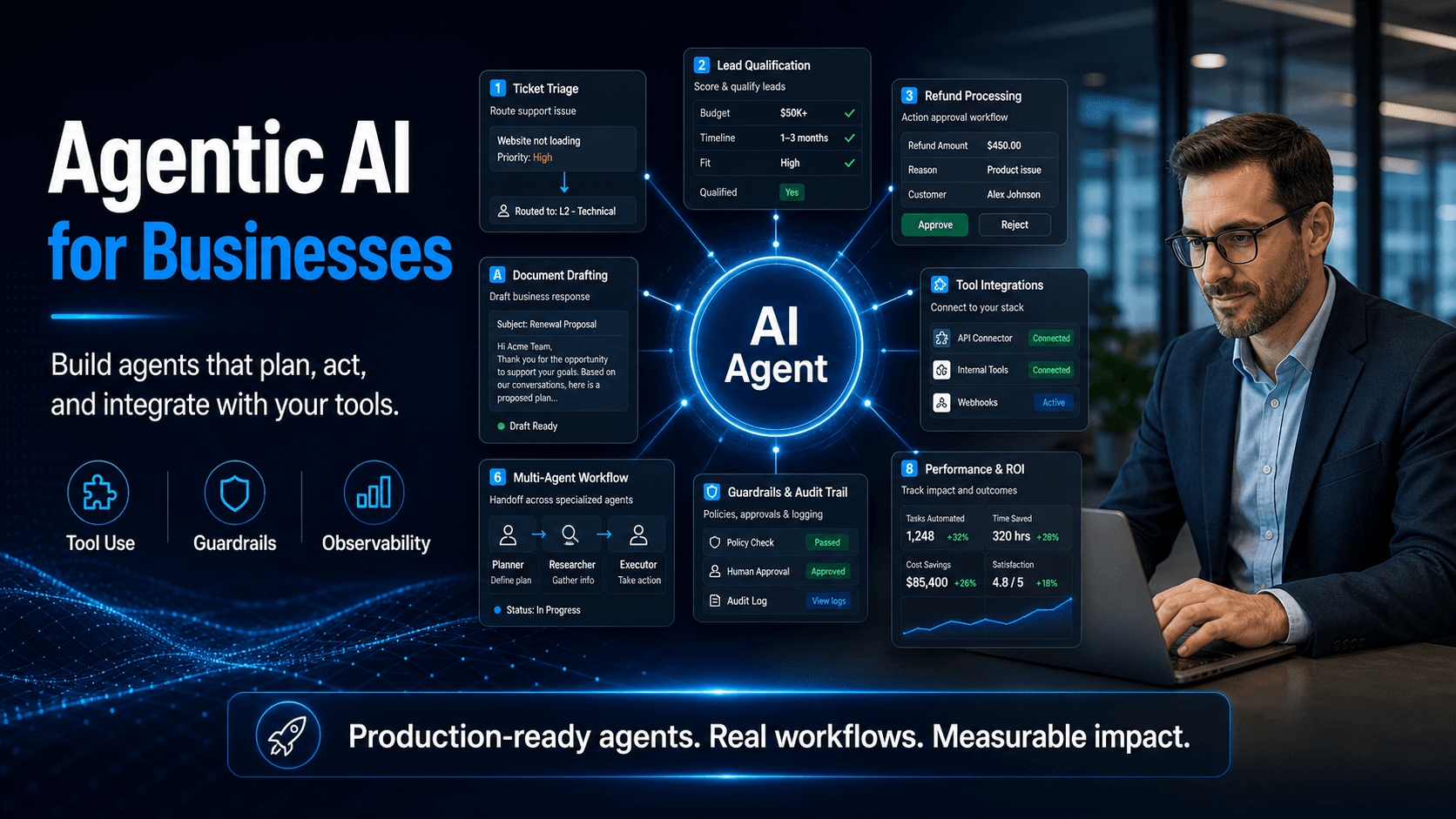
Ecorfy builds agentic AI systems for e-commerce and high-ticket online stores — custom AI agents that don't just answer shopper questions, they take real action: triaging support tickets, resolving order issues, processing returns and refunds, guiding shoppers through considered purchases, and orchestrating multi-step agentic workflows across your store platform, helpdesk, and operations stack. We design the agent, build the tool integrations, ship it with guardrails and observability, and operate it in production.
Prototype to production
Framework-agnostic builds
Observability + guardrails included
Where Most Agentic AI Projects Quietly Break Down
Building an AI agent that demos well is easy. Building one that holds up against real order volume and shopper edge cases is where most projects collapse. These are the six failures we see most often in e-commerce.
“Our store chatbot answers questions but can't actually resolve anything.”
A chatbot without tool use is a glorified FAQ. Real agents need to call your store APIs, look up orders, and take action — most teams stop at the conversational layer.
“The agent hallucinates order and product details when it matters most.”
Without grounding in your real catalog, order, and inventory data and validation on every tool call, agents fabricate plausible-sounding nonsense. The fix is architecture, not better prompts.
“It worked in dev but fell apart during a sales spike.”
Real shopper tickets and order edge cases are messier than test data. Without observability and edge-case handling, the first weird input breaks everything and you can't tell why.
“The agent is making refund and order decisions we can't audit.”
No reasoning logs, no decision trail. When a refund goes wrong (or right) you have no idea why. Finance teams hate this. High-ticket customers hate it more.
“Costs spiraled because the agent kept calling tools in loops.”
Without max-step budgets, retry caps, and cost dashboards, a single bad input can rack up hundreds of dollars in token spend before anyone notices.
“We can't tell if the agent is actually deflecting tickets.”
Agents without baseline metrics or resolution-rate tracking are just expensive guesses. ROI requires measurement built in from day one.
Done right, agentic AI fixes all six. We treat agents like production systems — not tech demos.
What Is Agentic AI?
Agentic AI describes systems where a large language model is given goals, tools, and the ability to plan and act autonomously. Unlike a store chatbot that just produces text in response to messages, an AI agent inspects an order, ticket, or shopper situation, decides what to do, calls store APIs or other tools, evaluates results, and either continues working toward the goal or hands off to a human when stuck.
Concretely, an agent has four ingredients: (1) a model that can reason — usually GPT-4, Claude, or Gemini, (2) a defined set of tools or store APIs it can call, (3) memory of what it has done and observed, and (4) guardrails that constrain what it's allowed to do. Together, those make agents capable of completing entire store workflows that previously required a support or ops person at every step.
Reports from Anthropic's research on building effective agents and McKinsey's analysis of agentic AI both converge on the same point: the e-commerce brands winning with agentic AI in 2026 are those treating it as a serious engineering discipline — not magic.
Agentic AI vs Chatbots vs Workflow Automation
People conflate these three constantly. They're solving different problems and have very different cost and complexity profiles.
| Capability | AI chatbots | Workflow automation | Agentic AI (this page) |
|---|---|---|---|
| Primary job | Answer questions | Run predefined sequences | Take action on goals |
| Decision making | None (responds) | Rule-based | Model-driven, runtime |
| Tool / API access | Limited (lookups) | Yes (predefined) | Yes (chosen at runtime) |
| Handles unknown steps | No | No (rules break) | Yes (plans & adapts) |
| Cost per execution | Low | Lowest | Higher (token spend) |
| Setup complexity | Low-medium | Low-medium | Medium-high |
| Best for | Support, FAQs, lead capture | Linear, predictable processes | Dynamic, judgment-heavy work |
Most online stores end up using all three together. Chatbots handle the conversational layer, workflow automation handles predictable pipelines like order syncs, and agents handle the judgment-heavy work in between.
Comprehensive Agentic AI Services
Six core service categories. Standalone or combined into a multi-agent platform tailored to your store operations.
1. AI Agent Strategy & Use Case Selection
Audit your store operations, identify the highest-ROI agent opportunities — order-issue resolution, returns, post-purchase outreach — and quantify the cost-per-ticket baseline that the agent has to beat. We are happy to tell you when an agent is the wrong answer and a simpler chatbot or workflow automation would do.
2. Custom AI Agent Development
Production-ready single agents built on OpenAI Agents SDK, Anthropic Claude Agent SDK, LangGraph, or custom code. We handle prompt engineering, tool definition, retrieval-augmented generation (RAG) over your catalog and order data, memory architecture, and edge-case handling. Every agent ships with guardrails and observability.
3. Multi-Agent Workflow Solutions
Orchestrated systems where multiple specialist agents coordinate to complete complex store workflows — e.g., a triage agent routing tickets to an order-resolution agent and a returns-processing agent, or a merchandising agent feeding a personal-shopper agent. We design the agent topology, hand-offs, and shared state.
4. AI Agent Integration: Store Platforms, APIs & MCP Servers
Agents are only as useful as the systems they can act on. We build the integration layer: Shopify, BigCommerce and WooCommerce admin APIs, helpdesks like Gorgias and Zendesk, 3PL and inventory systems, payment and refund processors, custom Model Context Protocol (MCP) servers, and webhook receivers. Every tool call is parameter-validated and rate-limited.
5. Agent Observability, Guardrails & Governance
Structured tracing of every reasoning step and tool call via LangSmith, Helicone, LangFuse, or Arize. Hard limits on max-token budgets, tool-call depth, and retry counts. Human-approval gates on irreversible actions. Audit-ready logs aligned with the NIST AI Risk Management Framework.
6. Ongoing Agent Operations & Optimization
Production agents need maintenance: prompt drift correction, model upgrades (GPT-4 → GPT-5 etc.), cost optimization (cheaper models for simple steps), new tool integrations, and incident response when behavior changes. We operate agents as a service so your team doesn't have to learn this on the fly.
How We Get Started: 3-Step Engagement Model
A predictable arc from kickoff to a working agent in production. No multi-quarter slideware projects.
Identify the Right Agent Use Case
We audit your store workflows and ticket mix, score opportunities by ROI and feasibility, define success metrics, and pick one initial agent to build. You get a clear plan even if you don't continue.
Build Agent + Tools + Guardrails
Build the agent, define its tools, integrate with your store platform and helpdesk, set guardrails and observability, and validate on real orders and tickets. Ships with a runbook, not a slide deck.
Production Rollout & Operate
Deploy with monitoring and human-in-the-loop, train your team, measure lift against baseline, and tune. Optional ongoing operations retainer for long-term maintenance.
Detailed Agentic AI Build Methodology (6 Phases)
For larger engagements we follow a six-phase delivery framework. Every phase has named deliverables, specific tools, and clear acceptance criteria.
| Phase | Timeline | Focus | Deliverable | Typical tools |
|---|---|---|---|---|
| 1. Discovery | Wks 1–2 | Use case selection & baseline metrics | Agent ROI brief | Workflow interviews |
| 2. Architecture | Wks 2–3 | Agent topology, tools, guardrails design | Agent design document | LangGraph, Mermaid diagrams |
| 3. Tool integration | Wks 3–5 | Build APIs, MCP servers, RAG layer | Working tool surface | FastAPI, MCP, Pinecone, LlamaIndex |
| 4. Agent build | Wks 5–7 | Prompt engineering, tool routing, memory | Functional agent | OpenAI Agents SDK, Claude SDK, LangGraph |
| 5. Hardening | Wks 7–9 | Guardrails, observability, edge cases, red-teaming | Production-ready agent | LangSmith, Helicone, LangFuse, Arize |
| 6. Operate & tune | Ongoing | Monitoring, prompt drift, model upgrades | Runbook + monthly reports | Custom dashboards, on-call alerts |
Agentic AI Use Cases by E-Commerce Store Type
Real agent use cases that produce measurable ROI for high-ticket online stores. These are the kinds of workflows where the cost-per-task math actually works.
Order management agents that handle freight scheduling, white-glove delivery windows, and damage claims; AI personal-shopping agents that build room sets from a customer's budget and style. Common stack: Shopify Admin API, Gorgias, OpenAI / Claude.
Concierge agents that answer authenticity, sizing, and engraving questions; VIP follow-up agents that proactively reach high-LTV buyers; returns and warranty agents that handle high-value items with care.
Product-fit advisor agents that recommend gear from a customer's goals and space; inventory replenishment agents for accessories and consumables; order-status and assembly-support agents.
Technical-support triage agents that resolve setup and compatibility questions; spec-comparison shopping agents; warranty and RMA agents that move tickets through end-to-end.
Regimen-advisor agents that recommend products from skin or wellness goals; subscription-management agents that handle pauses, swaps, and replenishment timing; review-response agents.
Customer-service triage agents that route niche product questions; AI shopping assistants grounded in a focused catalog; inventory and supplier-sync agents that keep stock accurate.
Is Your Online Store Ready for Agentic AI?
Agents are powerful but not always the right answer. Here's a quick honest check before you invest.
Signs you're ready
- You have a high-volume store workflow (support tickets, returns, order issues) that costs real time or money
- The workflow needs runtime judgment (not just predefined rules)
- You can articulate “done” for the agent — measurable success criteria like resolution rate
- Your store platform, helpdesk, and order data are accessible via API or can be made so
- You're willing to start with a narrow use case before scaling
- You have at least one person who can review agent decisions in early production
Signs you're not ready yet
- The work is fully predictable — workflow automation is cheaper
- The work is one-off and judgment-heavy — your team is cheaper
- Your store tools and platform have no APIs and can't be integrated
- You can't define what success looks like
- Cost per ticket is already very low (hard to beat economically)
- No appetite for human-in-the-loop during early production
Agentic AI Engagement Options & Pricing
Start small, prove ROI, then expand. Five engagement tiers for different stages and complexity.
| Engagement | Duration | Typical cost | Best for |
|---|---|---|---|
| Agent discovery sprint | 1 week | $1.5K–$3K | Validating fit before investing |
| Single-agent prototype | 2–4 weeks | $5K–$15K | One specific workflow |
| Production agent system | 6–10 weeks | $15K–$50K | Full integration + governance |
| Multi-agent workflow platform | 3–6 months | $50K–$200K+ | Complex multi-step processes |
| Agent operations retainer | Monthly | $2K–$10K/mo | Ongoing maintenance & tuning |
Final pricing depends on number of tools, integration complexity, data sensitivity, and SLA requirements. Token-spend costs (model usage in production) are billed at cost — no markup. Book a free call for a fixed-fee quote.
Agentic AI Decision Framework
The questions we work through with every e-commerce client during discovery.
Single agent vs multi-agent system
| Factor | Single agent | Multi-agent system |
|---|---|---|
| Setup cost | $5K–$50K | $50K–$200K+ |
| Token spend in production | Lower | Higher (more reasoning) |
| Debug complexity | Manageable | High (many failure modes) |
| Best for | Single coherent workflow | Distinct specialist roles |
| Default recommendation | Start here | Only when justified |
Build agent in-house vs hire agency vs use platform
| Factor | No-code agent platform | Agency (us) | In-house ML/AI engineer |
|---|---|---|---|
| Year 1 cost | $200–$2K/mo | $15K–$80K | $200K–$300K+ |
| Time to first production agent | Days (limited scope) | 2–10 weeks | 3–6 months after hire |
| Custom tool integration | Limited | Full | Full |
| Observability & governance | Basic | Production-grade | Depends on hire |
| Best for | Simple workflows, validation | Most growing e-commerce brands | Enterprise retailers |
When agents make sense vs when they don't
| Workflow shape | Right tool | Why |
|---|---|---|
| Predefined linear pipeline | Workflow automation | Cheaper, more reliable, no LLM cost |
| User asks question, gets answer | AI chatbot | Lower complexity, faster ship |
| Multi-step work with judgment at each step | Agentic AI | Where agents earn their keep |
| High-stakes irreversible action | Agent + human-in-the-loop | Agent prepares, human approves |
| Pure data transformation | Code (not agent) | Deterministic + cheap |
Frameworks & Platforms We Build Agents On
We are framework-agnostic. We pick the right tools for your scale, integration complexity, and team capability.
- OpenAI Agents SDK / Assistants
- Anthropic Claude Agent SDK
- LangChain / LangGraph
- LlamaIndex
- AutoGen, CrewAI
- Microsoft Semantic Kernel
- OpenAI GPT-4 / GPT-4o / o-series
- Anthropic Claude (Tool Use, Computer Use)
- Google Gemini
- Azure OpenAI / AWS Bedrock
- Open-source: Llama, Mistral
- Model Context Protocol (MCP)
- Custom REST/GraphQL APIs
- Zapier AI Actions
- Make MCP / Pipedream
- Webhook integrations
- Pinecone / Weaviate / Chroma
- Supabase pgvector
- Redis
- Postgres (with embeddings)
- Custom RAG pipelines
- LangSmith
- Helicone
- LangFuse
- Arize / Phoenix
- Custom dashboards
- AWS Lambda / ECS / Fargate
- Vercel / Cloudflare Workers
- Modal / Replicate
- Azure Container Apps
- Self-hosted (when required)
What You Get With an Ecorfy Agentic AI Engagement
- Agent design document: Topology diagram, tool surface, prompt strategy, memory architecture, and failure-mode analysis.
- Working production agent: Deployed and integrated with your store platform and helpdesk, not a Jupyter notebook demo.
- Tool integration layer: Store APIs, MCP servers, or custom adapters that let the agent act on real orders and systems.
- Guardrails & cost controls: Max-token budgets, tool-call depth limits, retry caps, human-approval gates on irreversible actions like refunds.
- Observability stack: Structured tracing of every reasoning step and tool call — you see exactly what the agent did and why.
- Evaluation harness: Test cases that run the agent against representative shopper inputs and measure resolution rate, latency, and cost.
- Operations runbook: Documented procedures for incident response, prompt updates, model upgrades, and adding new tools.
- Team training: Your team learns how the agent works and how to operate it. No black box.
- Optional ongoing operations: Monthly retainer for monitoring, tuning, and incident response.
Why E-commerce Brands Choose Ecorfy for Agentic AI
- We treat agents as production systems, not demos. Observability, guardrails, evaluation, and runbooks are non-negotiable, not optional.
- E-commerce focus. We work exclusively with online stores and high-ticket retailers, so we know the order, returns, and merchandising workflows agents actually need to handle.
- Honest about when agents are wrong. If a store workflow doesn't need agentic AI, we'll tell you and recommend workflow automation or a chatbot instead.
- End-to-end capability. Strategy through production through ongoing operations — same team that delivers our AI marketing and AI consulting engagements.
- Cost-aware. Token spend in production is real. We design with cost dashboards and hard limits from day one, not after the first surprise bill.
- No lock-in. Project-based or month-to-month. We hand off documentation and runbooks so your team can take over whenever you want.
Agentic AI FAQs
What is Agentic AI and how is it different from an e-commerce chatbot?
A chatbot answers shopper questions. An AI agent takes actions. Agentic AI uses large language models to plan multi-step work, call store APIs and tools, make decisions, and complete goals on its own — like resolving a delayed-order issue end to end, processing a return and issuing the refund, or building a personalized product set for a high-AOV shopper.
How is Agentic AI different from workflow automation tools like Zapier?
Workflow automation runs predefined steps based on rules you write. Agentic AI handles store work where the steps aren’t known in advance — the agent inspects the order, ticket, or shopper history, decides what to do, calls the right tools, and adapts when something unexpected happens.
How much does it cost to build a custom AI agent for my store?
A 1-week discovery sprint runs $1.5K–$3K. A single production-ready agent for one store workflow runs $5K–$15K. Full production agent systems run $15K–$50K. Multi-agent platforms range $50K–$200K+. Ongoing operations retainers run $2K–$10K per month.
How long does it take to build a custom AI agent for an online store?
A working prototype for a narrow use case takes 2–4 weeks. A production agent with platform integrations and guardrails typically runs 6–10 weeks. Multi-agent systems can take 3–6 months.
What frameworks do you use to build e-commerce AI agents?
We pick the right framework for your needs. Common choices: OpenAI Agents SDK and Assistants API, Anthropic Claude Agent SDK, LangChain / LangGraph, LlamaIndex, AutoGen, CrewAI, Microsoft Semantic Kernel, or custom builds against base LLM APIs.
Single-agent vs multi-agent systems: which does my store need?
Most online stores start with a single agent. Multi-agent systems make sense when you have a complex process with distinct specialist roles — like triage, order resolution, and post-purchase outreach — or when handing off between agents is genuinely cleaner than building one larger agent.
How do you prevent AI agents from hallucinating order or product details?
Multiple layers: ground the agent in your real catalog, order, and inventory data via retrieval (RAG), restrict it to a defined set of tools, validate every tool input and output, add reasoning checkpoints, and require human approval for irreversible actions.
How do you handle agent observability and debugging?
Every agent we build emits structured traces of its reasoning, tool calls, and outputs to LangSmith, Helicone, LangFuse, or Arize. You see exactly what the agent decided, why, what store tools it called, and where things went sideways.
How do you keep AI agent costs from spiraling out of control?
Hard limits: max-token budgets per task, maximum tool-call depth, retry caps, model-tier routing (cheap models for simple steps), and cost dashboards with alerting. We stress-test pathological inputs before deployment.
How do AI agents take actions safely on my store systems?
Through controlled tool use. Each agent has a defined set of permitted tools — read order, draft customer email, query inventory — with parameter validation on every call. Destructive actions like refunds and cancellations require human approval gates by default.
What about governance and compliance for agentic AI in e-commerce?
For stores handling sensitive customer and payment data we align with the NIST AI Risk Management Framework: documented model selection, audit trails on every agent decision, human oversight on consequential actions, data minimization, and DPAs with model providers.
How do you measure ROI on AI agent systems for an online store?
We track three layers: efficiency (tickets resolved per hour), quality (error rate, escalation rate, CSAT), and economics (cost per resolved ticket vs. human equivalent). Every engagement starts with baseline metrics so the lift is provable.
Can AI agents really replace my customer support team?
Some routine work — especially high-volume order and returns tasks. Most agents we build augment your team rather than replace it: the agent resolves the bulk of routine tickets and a human reviews edge cases and VIP shoppers. The right framing is "headcount efficiency" not "headcount elimination."
Related Reading
Ready to Build Your First Store AI Agent?
Book a free 30-minute consultation. We'll spend the time understanding your store operations, identifying where an agent could realistically help, and giving you an honest answer — even if that answer is “a chatbot or workflow automation would be cheaper.”
- Have high-volume order, returns, or support work that needs runtime judgment
- Have built a store chatbot but realized it can't resolve tickets end to end
- Want to automate beyond what Zapier or Make can handle
- Need agents that integrate with your store platform and helpdesk
- Care about observability, governance, and cost control