AI Chatbots for E-commerce Stores: Sell More & Support Shoppers 24/7
Ecorfy builds custom AI chatbots for e-commerce and high-ticket online stores — trained on your product catalog, spec sheets, and policies, integrated with Shopify, BigCommerce, or WooCommerce, and deployed wherever your shoppers are. Our AI chatbots answer pre-sale product questions, recommend the right products, track orders, handle returns, and deflect 60–70% of support tickets — turning hesitant browsers into confident buyers.
Of support tickets deflected
Customer service coverage
Typical time from kickoff to live
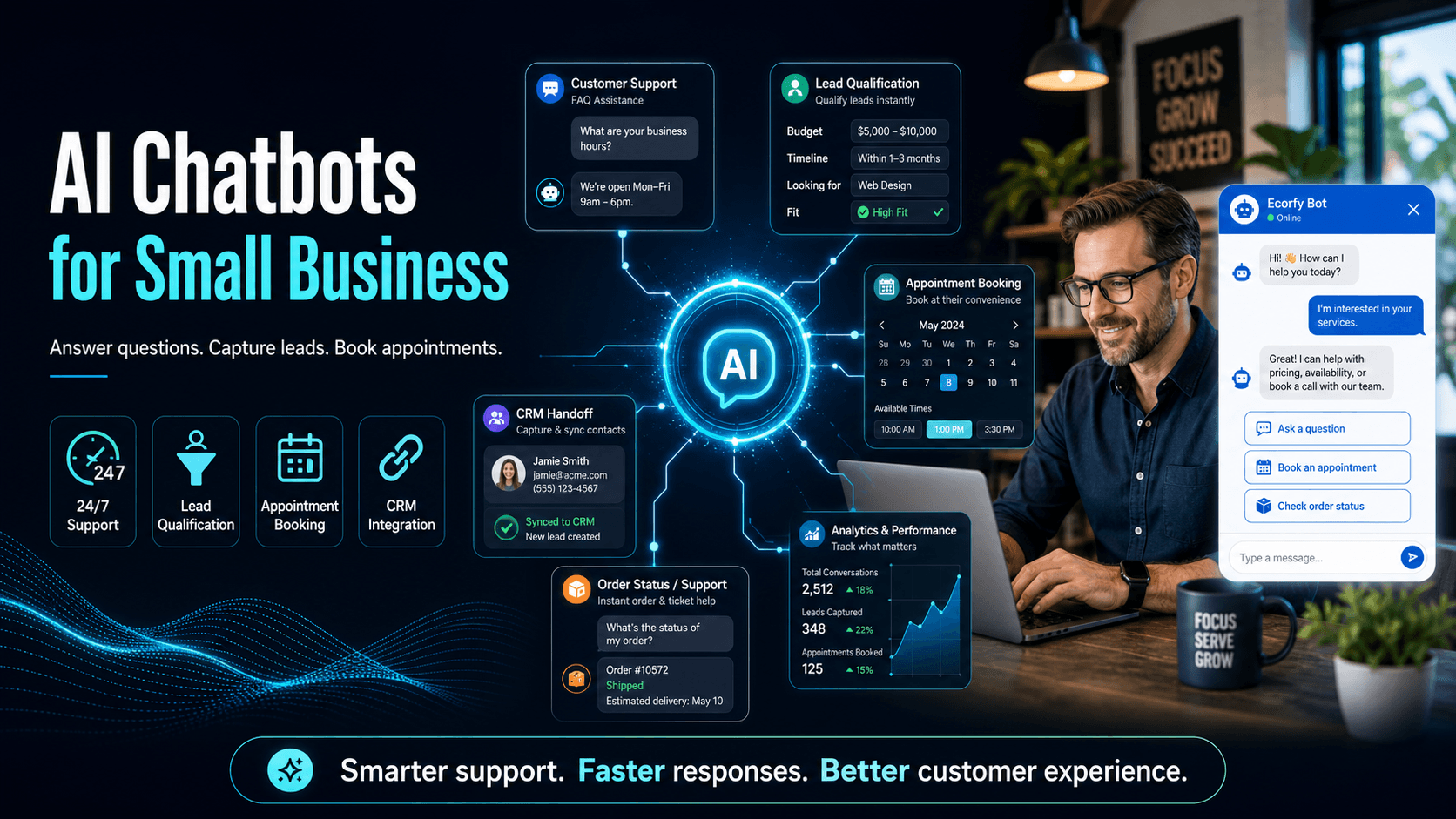
What Are AI Chatbots for E-commerce Stores?
An AI chatbot is a software agent that uses large language models (LLMs) like OpenAI GPT-4 or Anthropic Claude to hold natural conversations with your shoppers. Unlike old-school rule-based bots that follow rigid decision trees, modern AI chatbots for e-commerce understand intent, handle follow-up questions, and pull accurate answers from your knowledge base — product catalog, spec sheets, sizing guides, shipping and returns policies, and live order data.
The result: shoppers get instant, accurate answers around the clock, fewer carts are abandoned over an unanswered product question, and your support team stops fielding the same 20 order-status and returns questions every day. According to the Salesforce State of the Connected Customer report, 77% of customers expect to interact with someone immediately when they contact a company — a threshold only AI chatbots can meet 24/7.
Rule-based chatbots vs AI chatbots
| Capability | Rule-based chatbot | AI chatbot (LLM-powered) |
|---|---|---|
| Understands natural language | No — keyword matching only | Yes — understands intent & context |
| Handles unexpected phrasing | Breaks quickly | Handles it naturally |
| Answers from knowledge base | Only if pre-mapped | Retrieves and summarizes |
| Multi-turn conversations | Limited | Full context retention |
| Setup & maintenance | Build & maintain every branch | Train once, refine over time |
| Cost profile | Low upfront, high maintenance | Moderate upfront, low maintenance |
Benefits & Capabilities of AI Chatbots
Why e-commerce brands and high-ticket online stores are deploying AI chatbots in record numbers — and exactly what they can do for your storefront.
Why online stores need AI chatbots
- Instant answers. 77% of shoppers expect immediate service. AI chatbots answer product questions in seconds, any hour.
- Lower support costs. Deflect 60–70% of routine order-status and returns tickets — no need to add headcount as you scale.
- Recover the sale. Resolve pre-purchase hesitation on high-ticket items before the shopper abandons the cart.
- Consistent answers. Every shopper gets the same accurate product, sizing, and policy information — no conflicting replies.
- Multi-language. Modern LLMs handle 50+ languages out of the box — ideal for international DTC brands.
- Self-improving. Every conversation becomes training data. The bot gets smarter about your catalog over time.
Research backs this up: McKinsey's customer care research found that companies deploying AI in customer service cut resolution time by up to 50% and improve satisfaction scores simultaneously — the rare automation investment that lifts conversion and the shopper experience.
What our AI chatbots do for your store
- Pre-sale product questions: Answer spec, material, compatibility, and sizing questions so shoppers buy with confidence.
- Product recommendations: Guide shoppers to the right product, bundle, or upgrade based on their needs and budget.
- Order & shipping status: Look up live order, tracking, and delivery details and proactively flag delays.
- Returns & exchanges: Walk shoppers through your returns policy, start exchange requests, and answer warranty questions.
- Post-purchase support: Setup help, troubleshooting, and care instructions trained on your catalog and docs.
- High-ticket hesitation handling: Address financing, warranty, and authenticity concerns that stall considered-purchase buyers.
- Help-desk escalation: Route complex tickets to your team with full context preserved — nothing falls through the cracks.
AI Chatbot Use Cases by E-Commerce Store Type
AI chatbots for online stores look very different depending on what you sell. Here are the highest-impact customer-support use cases by high-ticket store type:
Freight and white-glove delivery status, dimension and material questions, damage-claim intake, room-and-style product guidance.
Authenticity and certification questions, ring-sizing and engraving help, gift and warranty support, concierge-style product recommendations.
Product-fit and sizing guidance, assembly and setup help, accessory recommendations, order tracking and returns.
Spec and compatibility questions, setup troubleshooting, warranty and RMA initiation, comparison guidance across models.
Regimen and ingredient questions, subscription management, replenishment reminders, bundle and product recommendations.
Niche product questions, order tracking, returns and exchanges, focused-catalog shopping assistance.
How We Build Your AI Chatbot: Process, Platforms & Channels
Our six-step process is designed to ship reliable, on-brand AI chatbots for e-commerce stores in 1–6 weeks — with the right platform, LLM, and deployment channels for your storefront.
Our 6-step build process
- Discovery & training data. We analyze your product catalog, spec sheets, sizing guides, policy pages, and support tickets to build an accurate knowledge base and identify which questions the bot should handle vs. escalate.
- Design & prompt engineering. We configure shopping flows, system prompts, guardrails, and brand voice. The chatbot is designed for your specific catalog and store — not a generic template.
- Integrations & handoff logic. Connect to Shopify, BigCommerce, WooCommerce, or your custom storefront and help desk. Configure live order lookup and when to escalate to human agents with full context.
- Testing & red-teaming. Test with real shopper scenarios, edge cases, and adversarial inputs. Make sure the bot doesn't hallucinate product details, share off-topic information, or behave badly.
- Launch & monitoring. Deploy live with a dashboard tracking deflection rate, CSAT, escalations, conversion impact, and most-asked questions.
- Continuous improvement. Monthly review of conversation logs to find catalog gaps, update training data, and refine prompts.
Platforms & LLMs we build on
We're platform-agnostic. We recommend the right stack for your scale, budget, and privacy requirements:
- OpenAI GPT-4 / GPT-4o: Highest accuracy for most conversational use cases.
- Anthropic Claude: Strong at following guardrails, great for regulated industries.
- Gorgias, Intercom Fin: Off-the-shelf help-desk AI if you're already on their platforms.
- Voiceflow, Chatbase: Faster deployments on a fixed budget.
- Custom RAG (retrieval-augmented generation): When you need tight control over what the bot can say about your catalog.
- On-premise / open-source LLMs: For sensitive shopper data that can't leave your infrastructure.
Deployment channels
We deploy your AI chatbot wherever your shoppers already are:
AI Chatbot Pricing for Online Stores
What does an AI chatbot cost for an e-commerce store? It depends on your catalog size and how much you customize. Here's a realistic range for each common approach:
| Option | Setup | Monthly | Best for |
|---|---|---|---|
| Off-the-shelf (Gorgias AI, Intercom Fin) | $0–$2K | $50–$500 | Stores already on those help desks |
| Mid-tier custom (Voiceflow, Chatbase) | $3K–$7K | $200–$800 | Brands wanting catalog & brand control |
| Fully custom RAG (GPT-4 / Claude) | $7K–$15K | $500–$1,500 | Large catalogs & deep store integrations |
| Enterprise / on-prem | $15K+ | $1,500+ | High-volume brands / strict privacy needs |
Monthly costs include LLM usage, hosting, and optimization. Pricing varies based on conversation volume, integrations, and SLA requirements. Our free AI consultation includes a scoped cost estimate for your specific use case.
Frequently Asked Questions About AI Chatbots
How much does an AI chatbot cost for an e-commerce store?
Custom AI chatbot projects typically range from $3,000 to $15,000 depending on catalog size, integrations, and training data. Ongoing hosting, LLM usage, and optimization add $200 to $1,500 per month.
How long does it take to build a custom AI chatbot for my store?
A basic AI chatbot trained on your product catalog, FAQs, and policy pages can go live in 1 to 2 weeks. More complex chatbots with order-lookup, help-desk integration, and custom shopping flows typically take 3 to 6 weeks.
Can the chatbot integrate with my Shopify store and help desk?
Yes. We integrate with Shopify, BigCommerce, WooCommerce, and custom storefronts, plus help desks like Gorgias, Zendesk, Intercom, and Freshdesk via API. The chatbot can look up live orders, attach context, and escalate with full history.
Will the chatbot get product details wrong or make things up?
Well-built AI chatbots use retrieval-augmented generation (RAG), which grounds answers in your actual catalog, spec sheets, and policy pages. We add guardrails that refuse to answer questions outside scope and always provide a handoff path to a human.
Will shoppers know they are chatting with AI?
We recommend transparency. Most modern AI chatbots are introduced as AI shopping assistants but feel conversational enough that shoppers are comfortable using them. Handoff to a human support agent should be seamless when needed.
What data do I need to train the chatbot?
Your product catalog, spec sheets, sizing guides, shipping and returns policies, and ideally 3 to 6 months of support transcripts. The more high-quality content we have, the more accurate the bot will be from day one.
Is my shopper and order data safe?
Yes. We use enterprise-grade LLM providers (OpenAI Enterprise, Anthropic, Azure OpenAI) that do not train on your data. For brands with strict privacy requirements, we deploy on dedicated infrastructure or self-hosted open-source models.
Related Reading
Is an AI Chatbot Right for Your Online Store?
- Get 50+ shopper inquiries per day that could be partially automated
- Sell high-ticket or considered-purchase products that prompt pre-sale questions
- Want 24/7 coverage without hiring overnight support staff
- Run on Shopify, BigCommerce, WooCommerce, or a custom storefront the bot can connect to
- Care about accurate product answers and on-brand voice